Solar energy is one of the fastest-growing sources of renewable power in the world. As electricity costs rise and environmental awareness increases, more homeowners and businesses are turning to solar panels to generate clean, sustainable energy. However, choosing the right type of solar panel can be confusing for beginners. This guide explains the main types of solar panels, how they work, their pros and cons, and how to choose the best one for different needs.
What Are Solar Panels?
A Solar panels (also known as “PV panels”) is a device that converts light from the sun, which is composed of particles of energy called “photons”, into electricity that can be used to power electrical loads.
Solar panels can be used for a wide variety of applications including remote power systems for cabins, telecommunications equipment, remote sensing, and of course for the production of electricity by residential and commercial solar electric systems.
On this page, we will discuss the history, technology, and benefits of solar panels. We will learn how solar panels work, how they are made, how they create electricity, and where you can buy solar panels.
Solar panels, also known as photovoltaic (PV) panels, are devices that convert sunlight into electricity. They are made up of many solar cells that capture sunlight and transform it into direct current (DC) electricity. This DC power is then converted into alternating current (AC) by an inverter, which can be used to power homes, offices, and other electrical devices.
Solar panels are typically installed on rooftops, open fields, or solar farms. They help reduce electricity bills, lower carbon footprints, and provide energy independence.
How Solar Panels Work
Solar panels work through the photovoltaic effect. When sunlight hits the solar cells, it excites electrons in the semiconductor material (usually silicon). These excited electrons move through the material, creating an electric current. The more sunlight the panel receives, the more electricity it produces.
The efficiency of a solar panel depends on several factors:
- The type of solar cell used
- The quality of materials
- The amount of sunlight exposure
- The temperature and installation angle
Main Types of Solar Panels
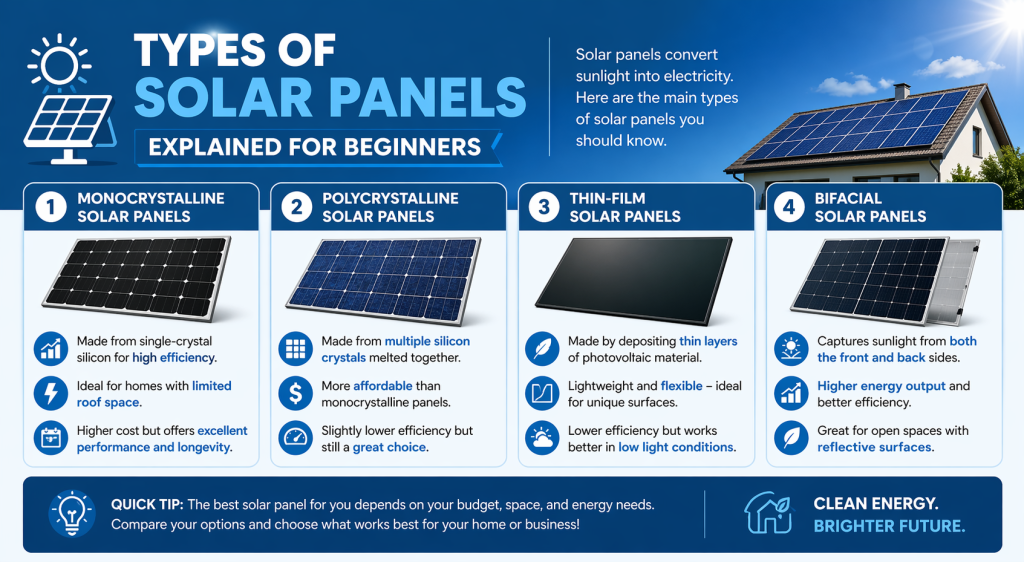
There are three main types of solar panels used today: monocrystalline, polycrystalline, and thin-film. Each type has unique features, advantages, and disadvantages.
-
Monocrystalline Solar Panels
Overview:
Monocrystalline solar panels are made from a single continuous crystal structure. They are easily recognized by their uniform dark color and rounded edges.
How They’re Made:
Manufacturers grow a single crystal of silicon, which is then sliced into thin wafers. These wafers are assembled into solar cells and connected to form a panel.
Advantages:
- High efficiency: Monocrystalline panels have the highest efficiency rates, typically between 18% and 22%.
- Space-saving: They produce more power per square foot, making them ideal for small roofs.
- Durability: They have a long lifespan, often lasting 25 years or more.
- Better performance in low light: They perform well even on cloudy days or in partial shade.
Disadvantages:
- Higher cost: The manufacturing process is more complex, making them more expensive.
- Waste during production: Cutting the silicon crystal creates waste material.
Best For:
Homeowners with limited roof space who want maximum efficiency and long-term performance.
-
Polycrystalline Solar Panels
Overview:
Polycrystalline panels, also known as multicrystalline panels, are made from multiple silicon crystals melted together. They have a bluish hue and a speckled appearance.
How They’re Made:
Fragments of silicon crystals are melted and poured into a mold, then cut into wafers. This process is simpler and cheaper than making monocrystalline panels.
Advantages:
- Affordable: They are less expensive to produce, making them budget-friendly.
- Good performance: Efficiency ranges from 15% to 17%, which is suitable for most residential uses.
- Environmentally friendly production: Less waste is created during manufacturing.
Disadvantages:
- Lower efficiency: They produce less power per square foot compared to monocrystalline panels.
- Less aesthetic appeal: The blue color and uneven texture may not look as sleek on rooftops.
- Slightly shorter lifespan: They may degrade faster under extreme heat.
Best For:
Homeowners with larger roof areas who want a balance between cost and performance.
-
Thin-Film Solar Panels
Overview:
Thin-film solar panels are made by placing one or more layers of photovoltaic material onto a substrate such as glass, plastic, or metal. They are lightweight, flexible, and have a sleek appearance.
Types of Thin-Film Panels:
- Amorphous Silicon (a-Si): Uses non-crystalline silicon.
- Cadmium Telluride (CdTe): One of the most common thin-film technologies.
- Copper Indium Gallium Selenide (CIGS): Offers higher efficiency among thin-film options.
Advantages:
- Lightweight and flexible: Easy to install on curved or irregular surfaces.
- Low cost: Cheaper to produce than crystalline panels.
- Better performance in high temperatures: They handle heat better than silicon-based panels.
- Uniform appearance: Sleek and modern design.
Disadvantages:
- Lower efficiency: Typically between 10% and 13%.
- Larger space requirement: More panels are needed to produce the same power as crystalline panels.
- Shorter lifespan: They degrade faster and may need replacement sooner.
Best For:
Large-scale installations, commercial buildings, or portable solar applications where flexibility and weight matter more than efficiency.
Comparing the Three Types
| Feature | Monocrystalline | Polycrystalline | Thin-Film |
| Efficiency | 18–22% | 15–17% | 10–13% |
| Cost | High | Medium | Low |
| Lifespan | 25+ years | 20–25 years | 10–20 years |
| Appearance | Black, uniform | Blue, speckled | Black, smooth |
| Space Efficiency | High | Medium | Low |
| Temperature Tolerance | Good | Moderate | Excellent |
Emerging Solar Technologies
The solar industry continues to evolve, and new technologies are being developed to improve efficiency and reduce costs.
-
Bifacial Solar Panels
These panels can capture sunlight from both sides, increasing total energy output. They are often used in open areas where sunlight can reflect off the ground.
-
PERC (Passivated Emitter and Rear Cell) Panels
PERC technology adds a reflective layer to the back of the solar cell, allowing it to capture more sunlight and improve efficiency.
-
Building-Integrated Photovoltaics (BIPV)
These panels are built directly into building materials such as windows, roofs, or facades, combining aesthetics with functionality.
-
Perovskite Solar Cells
A promising new technology that could offer high efficiency at a lower cost. Research is ongoing to improve their durability and commercial viability.
Factors to Consider When Choosing Solar Panels
Selecting the right solar panel depends on several factors:
- Budget: Determine how much can be invested upfront. Monocrystalline panels cost more but offer better long-term returns.
- Roof Space: Smaller roofs benefit from high-efficiency panels, while larger roofs can use lower-cost options.
- Climate: Thin-film panels perform better in hot climates, while monocrystalline panels excel in cooler or variable conditions.
- Aesthetic Preference: Some homeowners prefer the sleek black look of monocrystalline panels.
- Energy Needs: Calculate the household’s energy consumption to determine how many panels are required.
- Warranty and Lifespan: Choose panels with long warranties and proven durability.
Installation and Maintenance Tips
- Professional Installation: Always hire certified installers to ensure safety and efficiency.
- Regular Cleaning: Dust and debris can reduce performance. Clean panels every few months.
- Monitor Performance: Use monitoring systems to track energy production and detect issues early.
- Check for Shade: Ensure trees or nearby buildings do not block sunlight.
Environmental Benefits of Solar Panels
It provide numerous environmental advantages:
- Reduced carbon emissions: Solar energy produces no greenhouse gases during operation.
- Sustainable energy source: Sunlight is renewable and abundant.
- Reduced dependence on fossil fuels: Solar power helps decrease reliance on coal and oil.
- Minimal water usage: Unlike traditional power plants, it require little to no water.
The Future of Solar Energy
The future of solar energy looks bright. As technology advances, solar panels are becoming more efficient, affordable, and accessible. Governments and organizations worldwide are investing in solar infrastructure to promote clean energy and combat climate change. With innovations like transparent solar cells and solar roof tiles, solar power will soon blend seamlessly into everyday life.
Frequently Asked Questions (FAQ)
What are the main types of solar panels?
There are three primary types :
- Monocrystalline solar panels – made from a single crystal structure, known for high efficiency and sleek appearance.
- Polycrystalline solar panels – made from multiple silicon crystals, more affordable but slightly less efficient.
- Thin-film solar panels – lightweight and flexible, but generally lower efficience .
Which type of solar panel is the most efficient?
Monocrystalline panels are the most efficient, often reaching 18–23% efficiency. They perform better in limited space and low-light conditions compared to other types
Which solar panel type is the cheapest?
Polycrystalline panels are usually more budget-friendly. They offer a good balance between cost and performance, making them popular for residential use.
What are thin-film solar panels best used for?
Thin-film panels are ideal for:
- Large commercial installations
- Surfaces that can’t handle heavy loads
- Portable or flexible applications
However, they require more space due to lower efficiency.
How long do solar panels last?
Most of them last 25–30 years or more. Their efficiency may gradually decrease over time, but they continue producing electricity.
Conclusion
Understanding the different types is the first step toward making an informed decision about switching to solar energy. Monocrystalline panels offer top efficiency and durability, polycrystalline panels provide a cost-effective balance, and thin-film panels deliver flexibility and affordability. Each type has its strengths, and the best choice depends on budget, space, and energy goals.
By investing in the right solar technology, it’s possible to enjoy lower electricity bills, energy independence, and a cleaner planet for future generations.